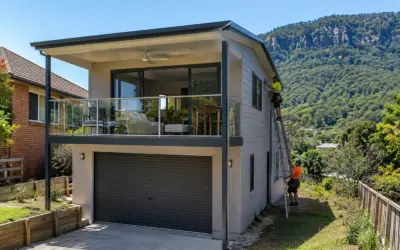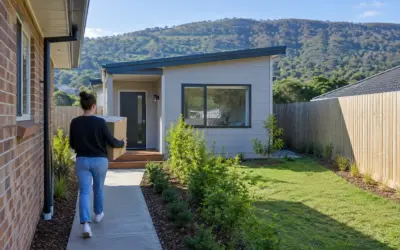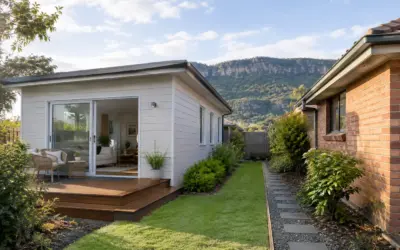

A lot of the calls we take start with the same worry. Someone in Dapto or Thirroul has heard that granny flat approval means lodging plans with council, waiting six months and maybe getting knocked back at the end of it. For most blocks in the Illawarra, that isn’t how it works anymore.
Getting the approval stage right can save you weeks of delays, unnecessary costs and a fair few headaches. This guide walks through the two approval pathways in NSW, which blocks qualify for the fast one, what goes into the application, how long each path really takes, and where projects around Wollongong, Shellharbour and Kiama tend to get stuck.
Yes, every granny flat needs approval. There are two ways to get it
All granny flats in NSW need formal approval before construction can begin. There’s no size small enough, and no prefab clever enough, to skip that step. What you do get to choose (if your block allows it) is the pathway.
There are two main approval pathways:
- Complying Development Certificate (CDC), assessed by a private accredited certifier against fixed state rules
- Development Application (DA), assessed by your local council on its merits
Each pathway has its place, but for most owners and investors the goal is to use the fastest and most predictable option wherever possible. Because the CDC rules are set by the state, they’re the same whether your property sits in Wollongong City Council, Shellharbour City Council, Kiama Municipal Council or Wingecarribee Shire Council in the Southern Highlands.
A CDC is the fast lane, and most suburban Illawarra blocks qualify
A CDC approval is the most common and efficient way to get a granny flat approved in NSW. It’s a combined planning and construction approval issued under the NSW Housing SEPP (State Environmental Planning Policy), so one document answers both questions: is this allowed here, and is it built to code?
It’s a streamlined approval process that bypasses council delays, provided your property and design meet specific criteria. If every box is ticked, the certifier issues the certificate. If one box isn’t, there’s no negotiating. The project goes to a DA instead.
The CDC checklist your block has to pass
To qualify for a CDC, your property and granny flat need to meet these rules:
- Minimum lot size of 450m²
- Minimum block width of 12 metres at the building line of the existing house
- Residential zoning under the local environmental plan
- Maximum granny flat size of 60m² (decks and balconies aren’t counted)
- Only one secondary dwelling per lot
- Side setbacks of at least 0.9 metres and a rear setback of at least 3 metres
- 3 metres clearance from trees taller than 4 metres
- Same ownership as the main house, with no subdivision or strata title
These requirements are designed to make sure the project fits within standard planning rules. In our experience, most suburban blocks that clear the 450m² and 12 metre marks are in good shape. The width rule is the one that catches people out, especially on older narrow lots closer to the coast.
What a CDC saves you, in real terms
Once the application is lodged with our certifier, CDC approval typically comes through in about 30 days. There’s no neighbour notification period, no council meeting to attend and no objections process. Overall costs are lower than a DA because you’re not paying council fees or keeping consultants on for months of back and forth.
The bigger win is certainty. For most Illawarra properties, CDC is the preferred pathway because if the criteria are met, approval follows. You can plan a build start date, line up finance and, if you’re an investor, work out when rent starts coming in.
What actually goes into a CDC application
This part surprises a lot of people. A CDC isn’t just a form. Before anything is lodged, a few specialists need to do their bit, and that pre-lodgement work adds a few weeks to the front of the timeline.
First, a licensed surveyor maps the exact boundaries, the position of the existing house and where the granny flat will sit, which confirms the setbacks. Next, a structural engineer prepares the slab design (based on a soil test) along with the frame and connection details. Then a BASIX assessor checks the design against the NSW Building Sustainability Index, the state’s energy and water efficiency rules, and issues the certificate the application needs. Only then does the full package go to the private certifier.
Because our designs have already been engineered and BASIX calibrated for CDC, our consultants aren’t starting from a blank page. That’s a big reason the stage moves quickly for us.
When a DA is the only way through
If your property doesn’t meet CDC requirements, you’ll need a Development Application (DA). This is the traditional council approval process, and it’s slower and less predictable.
Blocks that usually end up at council
The Illawarra has its share of tricky sites, so it’s worth checking these early:
- Lots under 450m² or narrower than 12 metres at the building line
- Heritage items or heritage conservation areas
- Flood affected land, common around Lake Illawarra and low lying parts of Dapto and Fairy Meadow
- Some bushfire prone land along the escarpment and through the Southern Highlands, depending on the risk rating
- Steep or unstable slopes that need geotechnical reports
- Sewer mains, easements or drainage lines running through the backyard
- A design that’s over 60m² or can’t meet the setbacks
None of these automatically rule out a granny flat. They just mean the standard CDC box doesn’t fit, so council has to look at the merits.
How the council DA process runs
The DA process typically involves:
- Submitting plans and reports to your local council
- Neighbour notification and an objection period
- Assessment by a council planner, often with requests for more information or design changes
- A decision to approve, approve with conditions, or refuse
On our numbers, a DA usually takes 3 to 6 months or more, compared with about 30 days for a lodged CDC. We work exclusively on CDC approvals, so if your block can’t go that way we’ll tell you plainly at the site inspection and you can decide what to do from there.
The rules every granny flat has to meet, whichever path you take
Regardless of the pathway, all granny flats must meet certain standards.
1. The zoning has to allow a second dwelling
Your property must be in a residential zone that allows secondary dwellings. You can check your zoning on a section 10.7 planning certificate from council, which also flags things like flood or bushfire affectation.
2. The site has to be buildable
Your block must be suitable for construction, including:
- Access for machinery and materials
- Proper drainage
- A manageable slope
3. The building has to meet national and state codes
All granny flats must comply with:
- The National Construction Code, which includes the Building Code of Australia (BCA)
- Fire safety requirements
- BASIX energy and water efficiency standards
These regulations make sure the dwelling is safe, functional and compliant, and they’re what the inspections during the build check against before the Occupation Certificate is issued at handover.
Where Illawarra approvals usually get stuck
Even straightforward projects can run into issues without proper planning.
Site constraints
Steep, narrow or irregular blocks may need design adjustments or a different approval pathway. We see this most on escarpment streets and older subdivisions with long, thin lots.
Utility connections
Connecting to sewer, water and electrical services can be more complex than expected, especially on older properties. A sewer main across the backyard can decide where the flat goes, or whether it fits at all.
Neighbour and privacy concerns
For DA approvals, issues such as privacy, overshadowing and overlooking can trigger delays or revisions. Under a CDC these are dealt with by the fixed setback and height rules, so there’s no objection period to sit through.
Extensions, sheds and decks follow different rules
We get asked about house extension council approval in the Illawarra more often than you’d think, usually by families deciding between adding rooms and adding a granny flat. The short answer is that an extension needs approval too, but not always from council. Many alterations and additions can be approved as complying development by a private certifier if they meet the state rules. If the design or the block doesn’t fit those rules, it’s a DA through Wollongong, Shellharbour, Kiama or Wingecarribee council.
Some smaller structures, like certain garden sheds, decks and pergolas, can be exempt development, meaning no approval at all, provided they stay within the size and setback limits in the state rules. A granny flat is never exempt. It’s a dwelling, so it always needs a CDC or a DA.
Extensions are custom by nature, so they’re more likely to trip something that pushes them to council. We build granny flats rather than extensions, but we’ve laid out the differences honestly in our comparison of extension and granny flat approvals, including when we’d tell you to extend instead.
How long granny flat approvals take, start to finish
- CDC: a few weeks of survey, engineering and BASIX work, then about 30 days once lodged
- DA: typically 3 to 6 months, sometimes longer
After a CDC is granted, signing the construction contract to breaking ground is typically 1 to 2 weeks, and our build runs for about 10 to 14 weeks to a tenant ready handover. Choosing the right pathway can change your overall project timeline by months, which matters a lot if rent or a parent’s move is waiting on the finish date.
Three things that speed approval up
To avoid delays and unnecessary complications, get a site assessment done before you spend money on drawings. That’s when lot width, sewer lines, trees and flood overlays show up. If you want to do some homework first, our guide on whether your Illawarra block can take a granny flat covers the checks.
Second, make sure all documentation is complete and accurate when it’s lodged. Missing reports are the most common reason certifiers come back with questions.
Third, start with a design that already fits the rules. Using proven granny flat designs drawn for CDC, with setbacks, engineering and energy ratings worked out in advance, can significantly speed up this stage.
Why working with the right team matters
Granny flat approvals can be complex, especially for first time builders or investors. An experienced team manages the surveyor, engineer, BASIX assessor and certifier for you, picks up site issues early and keeps the paperwork moving. You don’t need to find or manage a certifier yourself.
Our case studies from Thirroul and Dapto show how this plays out on real Illawarra blocks, from a family keeping a parent close to an investor chasing positive cashflow.
Start with your block, not the paperwork
For most properties, CDC approval offers the fastest and most efficient pathway, but the right approach always depends on your site. A quick look at the block usually tells us which way it’ll go.
If you’re unsure where your property stands, see how our CDC granny flat approval service works, or call us on (02) 4203 3554 to book a free site inspection anywhere in the Illawarra or Southern Highlands.
Granny flat approval questions we get asked
Can I build a granny flat on my property in NSW?
Most likely, if your lot is residential, at least 450m² and at least 12 metres wide at the building line of the house. Blocks that meet those rules can usually go through a CDC. Smaller or constrained sites may still be possible through a council DA.
How long does CDC approval take in NSW?
For our projects, approval typically comes through in about 30 days once the application is lodged with the certifier. The survey, engineering and BASIX work beforehand adds a few weeks.
What can I build without council approval in NSW?
Some minor structures, such as certain sheds, decks and pergolas, can be exempt development if they meet the state size and setback limits. A granny flat always needs approval, but if it qualifies for a CDC, a private certifier approves it instead of council.
Do you need council approval for renovations or extensions in NSW?
You need approval for most extensions, but not always from council. Many alterations and additions can be approved as complying development by a private certifier. If they don’t meet the state rules, they go to council as a DA.
What is the maximum size granny flat allowed in NSW?
Under the CDC rules, a granny flat can have up to 60m² of floor area. Decks and balconies aren’t included in that figure.
Can you have two houses on one title?
Yes, that’s exactly what a granny flat is. It sits on the same title as the main house and has to stay under the same ownership. It can’t be subdivided or strata titled off and sold separately.
How do I check if a granny flat or extension was approved?
Ask the owner or agent for the approval paperwork and the Occupation Certificate, and check with council, which can search its records for the property. Council’s online application tracker usually lists DAs and lodged CDCs. An unapproved structure can cause problems at sale time, so it’s worth checking before you buy.