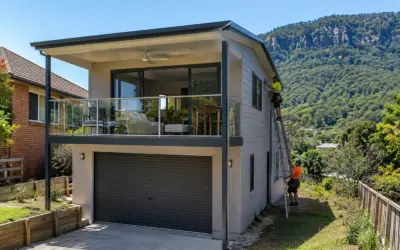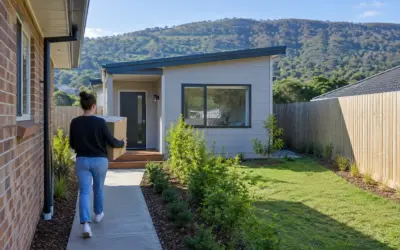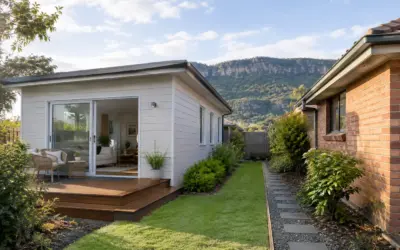

Most weeks someone rings us with a half finished spreadsheet and one question: are granny flats a good investment, or is that just something builders say? Usually they own a house in Dapto, Corrimal or Albion Park with a backyard nobody uses, and the mortgage on the place has started to bite.
Our honest answer is that a granny flat can be one of the better property moves available in the Illawarra. Not on every block, though, and not at any price. Below is how we run the numbers with owners, including the parts that rarely make it into the brochures.
We design and build second dwellings across the Illawarra and Southern Highlands, backed by Jaya Builds, a local construction company. So we see these sums play out on real blocks, not just on paper.
A second dwelling is simply a granny flat by its legal name
Under NSW planning law, a secondary dwelling (often called a second dwelling) is a self-contained home built on the same lot as your main house. “Granny flat” is the everyday name for exactly the same thing. Same rules, same building standard.
Unlike an extension or a renovation, a granny flat works on its own, with its own:
- Kitchen
- Bathroom
- Living space
- Entrance
That independence is what lets it earn rent and work as a real investment. One detail catches people out, though. The flat stays on the same title as the main house. You can’t subdivide it, strata title it or sell it separately, so its value sits inside the property as a whole.
The state rules come from the State Environmental Planning Policy (Housing) 2021, and these are the ones that decide most Illawarra blocks:
- Minimum lot size of 450m²
- Minimum lot width of 12 metres at the building line
- Maximum floor area of 60m², not counting decks or verandahs
- Side setbacks of at least 0.9 metres and a rear setback of at least 3 metres
- A main house must already exist, or be approved, on the lot
A quick note if you found this while searching from Geelong or anywhere else in Victoria: the rules there are different. Victoria has its own small second dwelling rules, so check with the Victorian Building and Plumbing Commission or your local council before leaning on any of the NSW figures in this post.
Why so many Illawarra owners are building one now
A second investment property is out of reach for plenty of people
With affordability the way it is, a lot of investors want better returns without buying another property. A granny flat gets you a second income stream without buying a second block of land, so there’s no second purchase price and no second round of stamp duty on land.
For many of the owners we meet, that is the whole appeal. They already own the land. The backyard is just sitting there.
Renters want small homes close to Wollongong
Rental demand across the Illawarra has stayed strong, driven by:
- Population growth
- University students and young professionals
- The pull of coastal living
In and around Wollongong, a tidy, private one or two bedroom flat with its own entrance doesn’t sit empty for long. That demand is what makes the investment case work here when it might not in a weaker rental market.
What a granny flat costs to build, and what it earns
Build prices vary more than people expect
Published price guides around NSW put a standard granny flat at roughly $120,000 to $200,000 built and finished. Basic studios sit at the bottom of that range. Bigger two bedroom flats with better finishes push toward the top, and a hard site can go past it.
For a real reference point, our Dapto and Thirroul example projects were both 58m² two bedroom flats, built on a fixed price of $260,000 turn key. That figure covered everything from site preparation through to the final clean and occupation certificate. When you compare prices around Wollongong, check what each quote includes, because a cheap number often leaves out site costs, service connections and approval fees. We break down what actually moves granny flat prices in NSW in a separate guide.
Rent: $420 to $650 a week for a good two bedroom flat
Rent depends on the suburb, the layout and the finish. These are the ranges we work with for a quality two bedroom granny flat:
- Wollongong and inner suburbs (Fairy Meadow, Thirroul, Figtree): $500 to $650 a week
- Shellharbour, Albion Park and Dapto: $420 to $550 a week
- Kiama, Berry and surrounds: $480 to $600 a week
Studios and one bedroom flats sit lower. That extra income can:
- Offset mortgage repayments
- Improve cashflow
- Turn a negatively geared property into a positive one
How the numbers looked on a Dapto investment property
Our Dapto case study shows how this plays out. The owners had a four bedroom brick veneer house on a 680m² block, rented for $720 a week, but it was still costing them $580 a week after the mortgage, rates, insurance and management fees. They were thinking about selling.
We built a 58m² two bedroom flat in the backyard for a fixed $260,000. The CDC approval came through in 30 business days and construction took 12 weeks. The flat leased within 10 days of listing at $600 a week. Combined rent across both dwellings is now $1,320 a week, and the property moved from losing $580 a week to roughly $20 a week ahead.
That $600 a week works out to $31,200 a year, or about 12 per cent of the build cost before expenses. To be clear, it is an example project on our case studies page showing a typical outcome. It is not a promise, and your block and suburb will give a different answer.
Why the return often beats buying another property
Compared with buying a second investment property, a granny flat usually offers:
- Lower upfront costs
- A faster path to rent
- Income as soon as it is finished
On a compliant block, our example projects went from signing to handover in about five months: roughly 2 weeks with consultants, around 30 business days for CDC approval, then 12 weeks of construction. Working from proven designs and a predictable approval path also cuts the risk of the budget drifting.
Tax can work for you, and occasionally against you
In some cases, the costs of building and running a rental granny flat may be tax deductible. That can include:
- Depreciation on a new build
- Maintenance and repairs
- Loan interest (if you borrowed to build)
The other side is worth knowing about too. Renting part of your own home can affect your capital gains tax position when you sell, and it may raise land tax questions. None of this is a reason not to build, but it is a reason to speak with your accountant before you sign anything, not after.
Two bedrooms is where most investors end up
If the block can take it, a two bedroom flat is usually the strongest balance of cost and rent. In the same suburb, it typically rents for $80 to $150 a week more than a studio or one bedroom equivalent. It also appeals to more people: couples, small families, single parents, housemates. A bigger pool of tenants means fewer empty weeks.
A 58m² layout fits two bedrooms with built-in robes, a full bathroom and open plan living inside the 60m² limit, with a deck on top that doesn’t count toward the floor area. You can see how we lay these out in our two bedroom granny flat designs.
To get the best rent out of whatever size you build:
- Pick a practical layout (two bedroom designs are the most popular)
- Use neutral, modern finishes
- Get good natural light and cross ventilation
- Include storage and parking where the block allows
When a granny flat is a poor investment
We’d rather you hear this from us than find out halfway through a build. These are the situations where the sums often don’t work.
You expect the valuation to jump by the build cost. A flat that costs $200,000 doesn’t automatically add $200,000 to your valuation the day it’s finished. The payback comes from rent over time plus capital growth, not an instant equity bump. We go through how much value a granny flat adds at resale in more detail.
The flat swallows the backyard. Families still want a yard. Trade the whole lot for a second dwelling and buyers will notice.
The block doesn’t suit the fast approval. Under 450m², narrower than 12 metres, flood affected land near Lake Illawarra, bushfire prone blocks on the escarpment edge or heritage streets can all push you toward a development application (DA) through council. That typically takes 3 to 6 months instead of weeks, and it can change what you are allowed to build.
Finance is tight. Lenders look at a single title property with two dwellings differently from a standard house, and some are more cautious than others. Talk to a broker about how the rent will be counted before you commit to a design.
The suburb doesn’t rent well. The case for a granny flat leans heavily on rent. If tenants in your street are hard to find, the numbers get thin quickly.
A word on kits, since they get searched a lot around Wollongong. A granny flat kit is a pile of materials, not a finished home. Someone still has to get approval, prepare the site, pour the slab, connect services, put it together and get it signed off. Once you add those costs, the gap to a builder’s turn key price is often much smaller than the kit price suggests.
Buying a house that already has a granny flat
Some people skip the build and look for an Illawarra house with a granny flat already on it. That can work well, but check a few things before you pay a premium for the flat.
Ask the agent or your solicitor for the approval paperwork (a CDC or DA) and the occupation certificate. An unapproved flat is a liability, not an asset, and it can limit who you can legally rent it to. Look at whether it has separate metering, its own entrance and its own yard, because tenants pay more for genuine separation. Ask for the rent history. Then compare the asking price with buying a house with a usable backyard and building new, since a brand new flat also comes with fresh depreciation and a fixed price.
It doesn’t have to stay a rental forever
Family close by, without sharing a kitchen
Granny flats let families live close together while everyone keeps their independence. They suit:
- Ageing parents
- Adult children
- Extended family
In our Thirroul example, a 74 year old mother moved from a unit 35 minutes away into a two bedroom flat 30 metres from her son’s back door. Step free entry, 820mm doorways and reinforced bathroom walls for future grab rails went in during the build, when they cost very little.
A home office at the bottom of the garden
A granny flat can also work as:
- A home office
- A studio or creative space
- Guest accommodation
That gives it a use in the years between tenants, or before the kids need it.
Room to change your mind later
A second dwelling gives your property options as life changes. Rent it now, move a parent in later, or live in it yourself and rent out the main house. The building stays useful either way.
Get these right before you build
Privacy decides the rent
A good granny flat feels like its own home, not the back half of someone else’s. That comes down to:
- Separate access paths
- Careful window placement
- A defined outdoor space for each dwelling
Services cost more on some blocks than others
Planning for services early saves money. Look at:
- Water and sewer connections
- Electrical capacity of the main house
- Metering (shared or separate)
Separate metering for power and water makes the flat much easier to rent and manage. It is standard in our two bedroom designs.
Approval comes first, and the path matters
Every granny flat in NSW needs approval before construction starts. Most compliant blocks can go through a complying development certificate (CDC), which a private certifier assesses against the state rules instead of council. Our example projects in Dapto and Thirroul were approved in 30 and 28 business days. A DA through council typically takes 3 to 6 months.
Knowing which path your block is on, before you pick a design, can save months. It is the first thing we check when we look at second dwellings on Illawarra blocks, along with lot size, width, setbacks and how services will reach the back of the yard.
A granny flat makes sense for you if most of these are true
A granny flat is a strong option if you:
- Want extra income from land you already own
- Have a block of at least 450m² with room in the backyard
- Own in a suburb where small rentals lease quickly
- Plan to hold the property for the long term
- Prefer a lower risk path than buying a second property
The short version
On the right block, in a suburb that rents well, a granny flat built to a fixed price is one of the more practical ways to improve how an Illawarra property performs. It earns from the week it is leased, and it keeps its use if your plans change.
If you want to know whether your block qualifies and what a flat might rent for in your street, call us on (02) 4203 3554 or have a look at how our second dwelling builds work and book a free site inspection from there.
Questions people ask about granny flat investment
Are granny flats a good investment in NSW?
They can be, if the block qualifies and the suburb rents well. The return comes mostly from rent: a quality two bedroom flat in the Illawarra typically rents for $420 to $650 a week depending on the area. Where it falls down is overspending on the build, losing the whole backyard, or building in a suburb with weak rental demand.
Do granny flats increase property value?
Usually, yes. CoreLogic data often quoted by agents suggests a well built granny flat can lift a property’s value by around 20 to 30 per cent, but that is a headline figure, not a promise. The value rarely rises by exactly the build cost on day one, so think about the rent and the long term return as well as resale.
Can you claim a granny flat on tax?
If you rent it out, costs such as depreciation, maintenance and loan interest may be deductible. Renting part of your home can also affect capital gains tax when you sell. Get advice from your accountant on your own situation before you build.
Can I build a granny flat for $100,000?
It’s unlikely for a finished, approved flat. Published NSW price guides start at around $120,000 for basic builds, and site costs like slope, access and service connections move the number up. Kits can look cheaper, but the kit price usually covers materials only.
How much does a 2 bedroom granny flat cost in NSW?
Price guides put most granny flats between about $120,000 and $200,000, with two bedroom flats toward the top of that range. Our Dapto and Thirroul example projects, both 58m² two bedroom flats, were built for a fixed $260,000 turn key, including site preparation, approvals and the occupation certificate.
Do I need council approval for a granny flat in NSW?
You need approval, but not always from council. If your block meets the state rules (including a 450m² minimum lot size and 12 metre width), a private certifier can issue a complying development certificate. Otherwise it goes to council as a development application, which typically takes 3 to 6 months.
What are the disadvantages of a granny flat?
You lose backyard space, the flat can’t be sold separately because it stays on one title, and privacy needs careful design if you live in the main house. Some lenders are also more cautious with properties that have two dwellings on one title, so talk to a broker early.