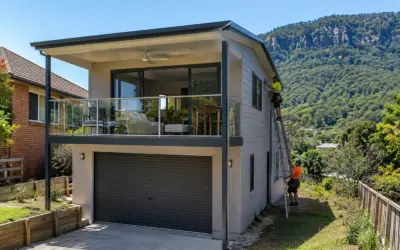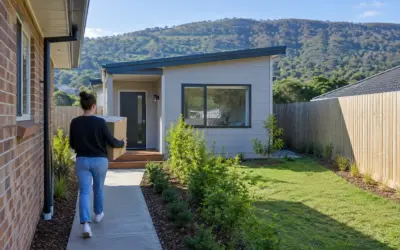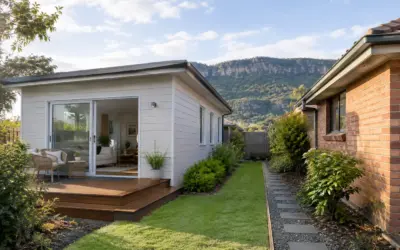
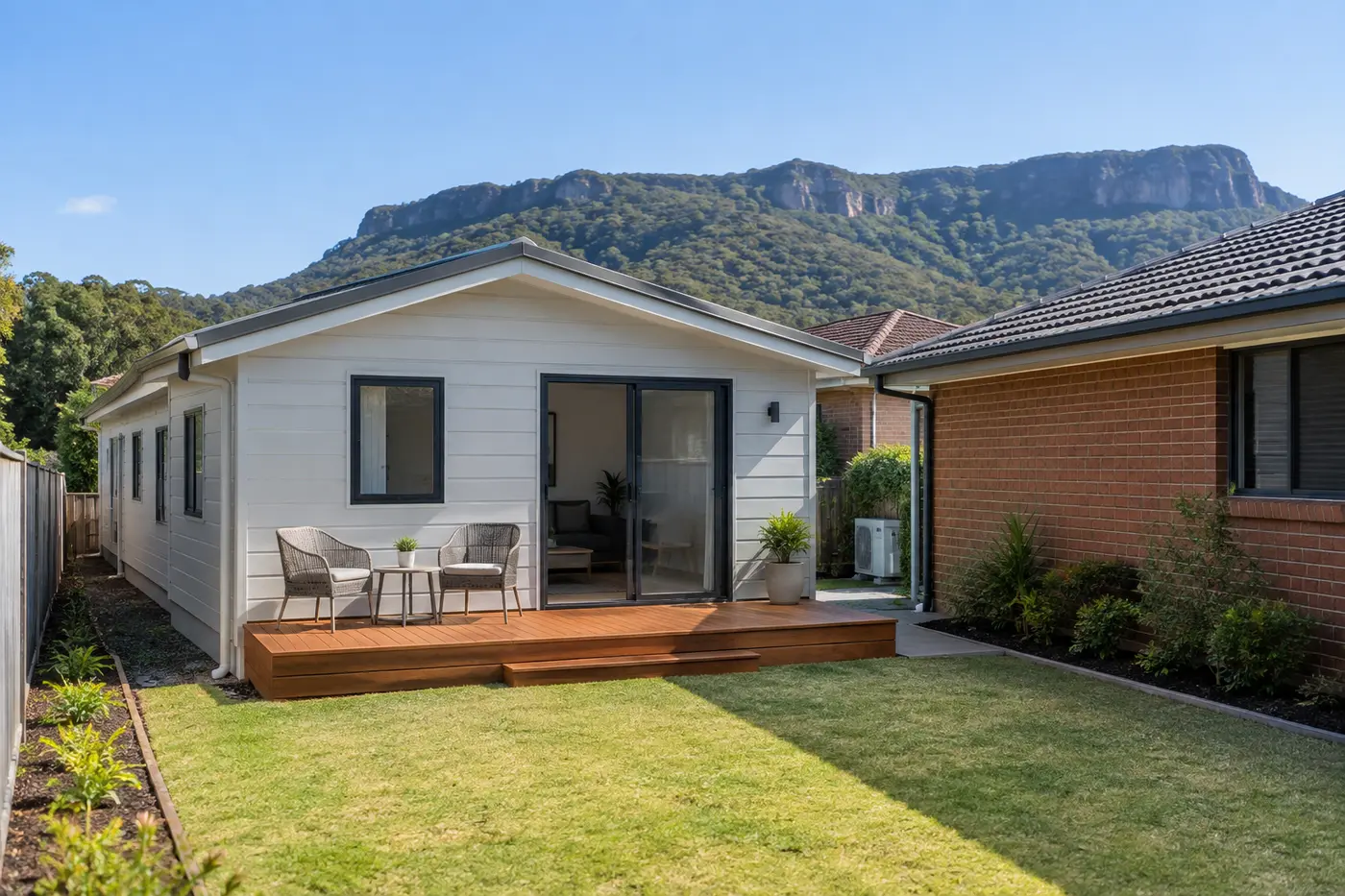
The call usually starts the same way. A family in Corrimal or Albion Park has run out of room. Mum is getting older, or the eldest is back from uni and not leaving any time soon, and someone says “why don’t we just put on an extension?” Then someone else says “what about a granny flat?” and the conversation stalls on one question: which one is easier to get approved?
We build granny flats, not extensions, so we have a side in this. But we get asked about house extension vs granny flat approvals often enough that a straight comparison seems useful, including the cases where an extension really is the better call.
Both can skip the council queue, if the design fits the rules
Most people assume any extension means lodging plans with Wollongong, Shellharbour, Kiama or Wingecarribee council and waiting. That’s not quite right. In NSW there are two main approval paths, and both kinds of project can use either one.
The first is a Development Application (DA). You lodge plans with council, neighbours may be notified, and a council planner assesses the proposal on its merits. It’s the flexible path. It’s also the slower, less predictable one.
The second is a Complying Development Certificate (CDC). This is the fast track, where a private certifier signs off a design that meets a fixed set of state rules instead of it waiting in a council queue. If the project ticks every box, it gets approved. If it misses one, it goes back to the DA path.
So the real question isn’t “extension or granny flat”. It’s “which of these is more likely to fit neatly inside the CDC rules on my block?”
Why granny flats tend to have the easier run
A detached granny flat (the planning term is “secondary dwelling”) is a new, separate building in the backyard. That keeps the approval simple. The certifier is checking a known design against known rules: the 60 m² cap on internal floor area, setbacks, height, lot size and so on.
That’s why we only build fixed designs drawn for CDC. When the design has already been worked through the rules, the approval stage becomes paperwork and site checks rather than a negotiation. Our granny flat approval service handles that side for you, from the site assessment through to the certificate.
Extensions are a different animal. Every one is custom, because every house is different. The certifier or council has to look at how the new work ties into an existing building that might have its own quirks, earlier additions and sometimes unapproved work nobody told you about. Alterations and additions can go through CDC too, but owners are more likely to hit something that pushes them into a DA: a second storey that overshadows a neighbour, a rear addition that eats into the setback, or an older home whose existing structure doesn’t match the plans on file.
If you want the full detail on how the granny flat side works locally, our guide to granny flat approvals in the Illawarra covers each step.
The same site problems send either project back to council
Some blocks are going to need a DA no matter what you build. This part of the state has plenty of them, so it’s worth checking early:
- flood affected land, common around Lake Illawarra and low lying parts of Dapto and Fairy Meadow
- bushfire prone land along the escarpment and through much of the Southern Highlands
- heritage items or heritage conservation areas
- steep or unstable slopes, where geotechnical reports come into play
- easements, sewer mains or drainage lines running through the backyard
These hit extensions and granny flats alike. The difference is where the constraint sits. A sewer main across the backyard might rule out a flat but leave an extension at the side of the house untouched. Equally, a heritage listing can make changes to the main house hard while a flat tucked out the back is far less visible from the street. If you’re not sure what’s on your title, our post on whether your block suits a granny flat walks through the checks.
Living through the build is a bigger deal than people expect
This one surprises people. An extension means opening up the house you live in. Walls come out, the roof gets cut into, and for a stretch the kitchen or bathroom might be out of action. Some families move out for part of the job. Others stay and put up with dust and trades in the hallway.
A granny flat goes up in the backyard. You’ll notice the noise and the trucks, but your front door, kitchen and bathroom keep working the whole time. For a household with young kids, or an older parent already living there, that alone often settles it.
You end up with two very different things
This is the part that matters most, and it has nothing to do with approvals.
An extension makes your house bigger. That’s it. The new rooms are part of the main home, sharing its kitchen, its front door and its power bill. You can’t lease an extension as a separate dwelling.
A granny flat is a second, self-contained home with its own kitchen, bathroom and entrance. That opens up options an extension never will.
Family now, rental later. Ageing parents can live independently a few metres away. When that chapter ends, the flat can be rented out rather than sitting empty as a spare room.
Privacy on both sides. An adult child gets their own space and you get yours back. Nobody is queuing for the shower at 7 am.
Income, if that’s the goal. Plenty of our clients build purely as an investment. Our Dapto investor case study follows one owner who used a flat to move a property from negative gearing to positive cashflow.
The flip side deserves saying too. If what you actually want is a bigger kitchen, a second living area for the kids, or a main bedroom with an ensuite, a granny flat doesn’t do that. It’s a separate home, not more house.
When we’d tell you to extend instead
We’d rather lose a job than build the wrong thing. An extension is usually the better choice when:
- the extra space needs to connect to your existing living areas
- the backyard is too small, too steep or too constrained for a compliant flat
- you have no interest in ever renting the space out
- the family wants to stay under one roof, literally
If two or more of those describe you, talk to a good extension builder. If most of them don’t, a granny flat is worth pricing before you commit.
Cost is harder to compare than you’d think
People often ask which is cheaper. Honestly, they aren’t priced the same way. An extension is quoted around your existing house, so the price can move with whatever the builder finds once walls come open. A fixed granny flat design is a known quantity, so the build price is much easier to pin down before you start. What changes from block to block is site works, access and service connections.
For the granny flat side, our breakdown of granny flat costs in NSW goes through what’s in a typical quote and what tends to get left out.
Start with a look at the block
Nearly every extension vs granny flat decision comes down to two things: what your block will allow, and what you need the space to do. We can tell you quickly whether a CDC granny flat fits, and if it doesn’t, we’ll say so. Have a look at how our CDC approvals process works, or call us on (02) 4203 3554 to talk it through for your property anywhere in the Illawarra or Southern Highlands.
Common questions about granny flats and extensions
Is it cheaper to extend or build a granny flat?
It depends on the house and the block, so neither is always cheaper. Extensions carry more unknowns because the builder is working into an existing structure. A fixed granny flat design gives you a clearer build price, with site works and connections being the main variables.
Do I need council approval for a house extension in NSW?
You need approval, but not always from council. Many alterations and additions can be approved as complying development by a private certifier if they meet the state rules. If the design or the block doesn’t fit those rules, you’ll need a DA through council.
Can I rent out an extension like a granny flat?
No. An extension is part of your main house, so it can’t be leased as a separate dwelling. A granny flat is approved as a secondary dwelling with its own kitchen, bathroom and entrance, which is what allows it to be rented.
Is a house with a granny flat worth more?
Often, because buyers see a second income stream or room for family. How much it adds depends on the suburb, the quality of the flat and whether it was properly approved. An unapproved structure can work against you at sale time.
What are the disadvantages of a granny flat compared to an extension?
You give up backyard space, and the flat doesn’t make your main house any bigger. It also has to fit within the 60 m² limit and the setback rules, which some narrow or steep blocks can’t meet.
Can a granny flat be attached to the house?
Yes, a secondary dwelling can be attached in NSW, but it still has to be self-contained and meet the same size rules. The flats we build are standalone fixed designs, which keeps approval and construction simpler.