You get two quotes back for the same backyard. One builder talks about modules turning up on a truck and being craned into place in a day. The other talks about slabs, frames and a crew on site for a couple of months. Same idea, very different way of getting there, and the prices don’t line up neatly either. That is the moment most people start asking whether a prefab or a built-on-site granny flat is the smarter call.
We build granny flats across the Illawarra and Southern Highlands, so we field the prefab vs built granny flat question most weeks. There is no single right answer. It depends on your block, your budget and what you plan to do with the place once it’s finished. Here is how we talk it through with people, minus the sales spin.
First, what the two words actually mean
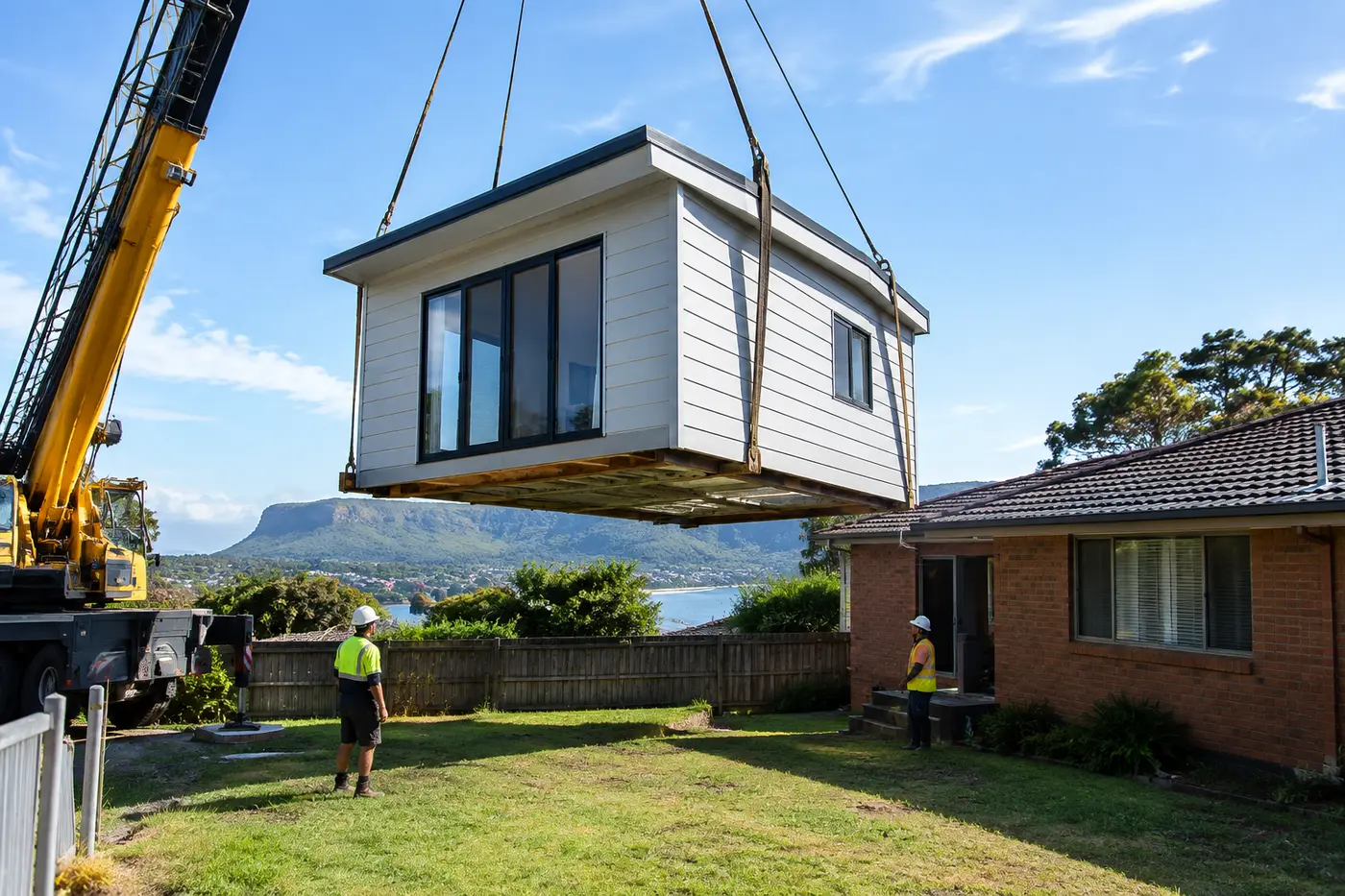
“Prefab” (short for prefabricated) covers granny flats that are built somewhere else, usually in a factory, then delivered to your property. Modular is the most common type: whole rooms or sections arrive finished, get lifted off a truck and joined together on your slab. Kit homes are the flat-pack cousin, delivered as a bundle of parts to assemble on site.
A built-on-site granny flat is the traditional way. The slab, frame, roof, cladding and fit-out all happen in your backyard, start to finish. Nothing turns up pre-assembled. Both end up as a proper self-contained dwelling. The difference is where most of the work gets done.
Where prefab genuinely wins
Speed on site is the big one. Because the box is being built in a factory while your slab cures, the disruptive part of the job, the bit happening in your yard, is much shorter. If you’re renting out the main house or you’ve got neighbours close by, fewer weeks of trucks and noise is worth something.
Cost certainty is the other draw. A factory building the same model over and over tends to price it tightly, so you often see a lower upfront number and fewer nasty surprises along the way. Weather delays matter less too, since rain doesn’t stop a factory line the way it stops a backyard crew.
Where a built-on-site granny flat pulls ahead
Flexibility is the honest advantage. When we build on site we can shift a wall, change a window, match the brick or render to your existing home, and work around a slope or an awkward corner without forcing your plan into a fixed factory template. Illawarra blocks are rarely flat and tidy, and that freedom counts.
Finish and integration tend to be stronger as well. A site build can tie into your home’s look so the granny flat reads as part of the property rather than a pod dropped in the yard. For resale and for the kind of tenant you attract, that matters more than people expect. Some lenders and valuers also lean towards a fixed, permanent build when they put a figure on the property.
The part the brochures skip: access and site works
This is where a lot of prefab plans come unstuck, so it’s worth being blunt. A modular granny flat has to physically get to the spot it’s going. That means truck access down the side of your house and room for a crane to swing it into place. Tight blocks, steep driveways, low powerlines and big trees all get in the way, and craneage isn’t cheap when it’s tricky.
And whichever route you pick, the groundwork is much the same. You still need a slab or footings, drainage, plumbing, power and stormwater connected on site. Prefab shortens the build, not the site prep. People compare a factory price against a full site-built quote and forget the delivery, crane and connection costs sitting underneath the prefab number. Line the quotes up properly before you decide.
Approval works the same for both
Good news here. In NSW, a granny flat can usually be approved as complying development (CDC), which is the faster approval path, whether it’s prefab or built on site. What matters to the approval is that the design and the block meet the standards, not how the thing gets constructed. The same size limits and setback rules apply either way, so don’t pick prefab expecting an easier tick from council, or built expecting a harder one. If you want the full rundown, our guide to how long a granny flat takes to build walks through where the weeks actually go.
What it costs, and what you get back
Prefab is often cheaper to buy and quicker to stand up. A site build usually costs a bit more and takes longer in your yard, but gives you a home that’s tailored to the block and, in a lot of cases, easier to finance and value. Neither is automatically the better deal. It comes down to what you’re optimising for: lowest upfront number, or the strongest long-term result on the property. We break the money side down properly in our post on what a granny flat costs in NSW, including the site costs that catch people out.
How we build, and why
We took a middle path on purpose. We design and build fixed-design, CDC-approved granny flats on your block, backed by Jaya Builds, a local Illawarra construction company. So you get a lot of what makes prefab appealing, a proven design and a predictable process, without giving up the things a site build does well: proper integration with your home, a build suited to your actual block, and the quality of a permanent construction. If you want to see how the build side runs from slab to handover, our granny flat construction service lays out the whole process.
That approach suits the Illawarra, where blocks slope, sit near the escarpment or back onto bushland, and a one-size factory box often doesn’t fit. It also suits investors, who care less about how the granny flat arrives and more about the rent it pulls and the value it adds.
So which should you choose?
Lean prefab if your block has easy truck and crane access, you want the shortest possible disruption, and a standard layout works for you. Lean built-on-site if your block is tight or sloped, you want the granny flat to match your home, or you’re building for long-term value and rental appeal. If you’re not sure which camp you’re in, that’s exactly what a site inspection sorts out, because access and slope decide more than any brochure can.
Not sure whether your yard can even take a crane, or whether a site build makes more sense? We’ll come out, look at the block and give you a straight answer. Call the team on (02) 4203 3554 or book through our granny flat build page, and we’ll tell you what actually fits your property.
Common questions about prefab and built granny flats
How long do prefab granny flats last?
A well-made prefab granny flat is built to the same building standards as a site build, so it should last just as long, decades, with normal upkeep. Longevity comes down to build quality and materials, not whether it was assembled in a factory or your backyard. Ask any supplier about their structural warranty before you commit.
What’s the cheapest way to build a granny flat?
A basic prefab or kit model on a flat, easy-access block is usually the lowest upfront cost, because the design is standardised and the on-site labour is short. The catch is site works, delivery and crane hire, which can close the gap fast on a difficult block. Get a quote that spells out those costs, not just the price of the building itself.
Are prefab granny flats worth it?
They can be, when the block suits them and speed matters to you. The main drawbacks are limited design flexibility, the need for good truck and crane access, and financing that some lenders treat more cautiously than a permanent site build. If those aren’t dealbreakers for your situation, prefab is a fair option.
Can you get a prefab granny flat approved under CDC in NSW?
Yes. Complying development approval looks at the design and the block against the NSW standards, not the construction method. A prefab or modular granny flat can go through CDC just like a site-built one, as long as the design and your property meet the requirements.
What’s the difference between prefab, modular and kit granny flats?
Prefab is the umbrella term for anything built off site. Modular means finished sections or whole rooms are made in a factory and craned onto your slab. A kit home arrives as a flat-packed bundle of parts to assemble on site. All three are off-site approaches, they just differ in how complete they are when they reach your block.
Do prefab granny flats add less value than built ones?
Not always, but a site build that matches your home and sits well on the block often presents better to buyers and valuers. A quality prefab in the right spot still adds real value. What moves the number most is the finished result and how well it fits the property, more than the way it was constructed.