You have run the numbers, the block looks like it will fit one, and you are close to going ahead. Then the real question lands: how do you actually pay for it? Very few people we talk to have the full build cost sitting in a savings account, and honestly, they usually should not use it even if they do. Working out how to finance a granny flat in NSW is the step that trips people up more than approvals or design ever do, so this is the part we get asked about most.
We build granny flats, we are not a bank or a mortgage broker, so treat this as a builder’s plain-English map of your options rather than personal financial advice. Your own lender or broker signs off on the actual numbers. What we can do is tell you how most of our clients fund their build, and what tends to go smoothly versus what causes delays.
Most people fund it one of two ways
Strip away the jargon and there are really two common paths. You either borrow against the value already sitting in your home, or you take out a construction loan that pays the builder in stages as the job progresses. A fair few people end up using a bit of both. Cash savings play a part for some, usually to cover the smaller upfront costs rather than the whole thing.
Which one suits you comes down to how much equity you have, whether you still have a mortgage, and how comfortable you are adding to your loan. Let’s walk through each.
Borrowing against the equity in your home
Equity is just the gap between what your property is worth today and what you still owe on it. If your home is valued at more than your loan balance, that difference is equity, and lenders will usually let you borrow against a chunk of it. For a lot of Illawarra owners who bought years ago, this is the simplest route, because the money is effectively already there.
The appeal is that the loan is secured against a property you already own. Because of that, some lenders will fund the full build cost this way, so you may not need to save a separate cash deposit the way you would when buying a house. You are increasing your home loan rather than taking out a brand new product, which keeps the paperwork lighter.
The trade-off is honest and worth saying plainly: you are borrowing more against your home, so your repayments go up. That is fine if the granny flat is going to earn rent that more than covers the extra, and it is worth thinking twice about if it will not. This is exactly why it pays to know what the finished build is likely to be worth before you commit, and we cover that in our piece on the value a granny flat adds to an Illawarra property.
How a construction loan actually works
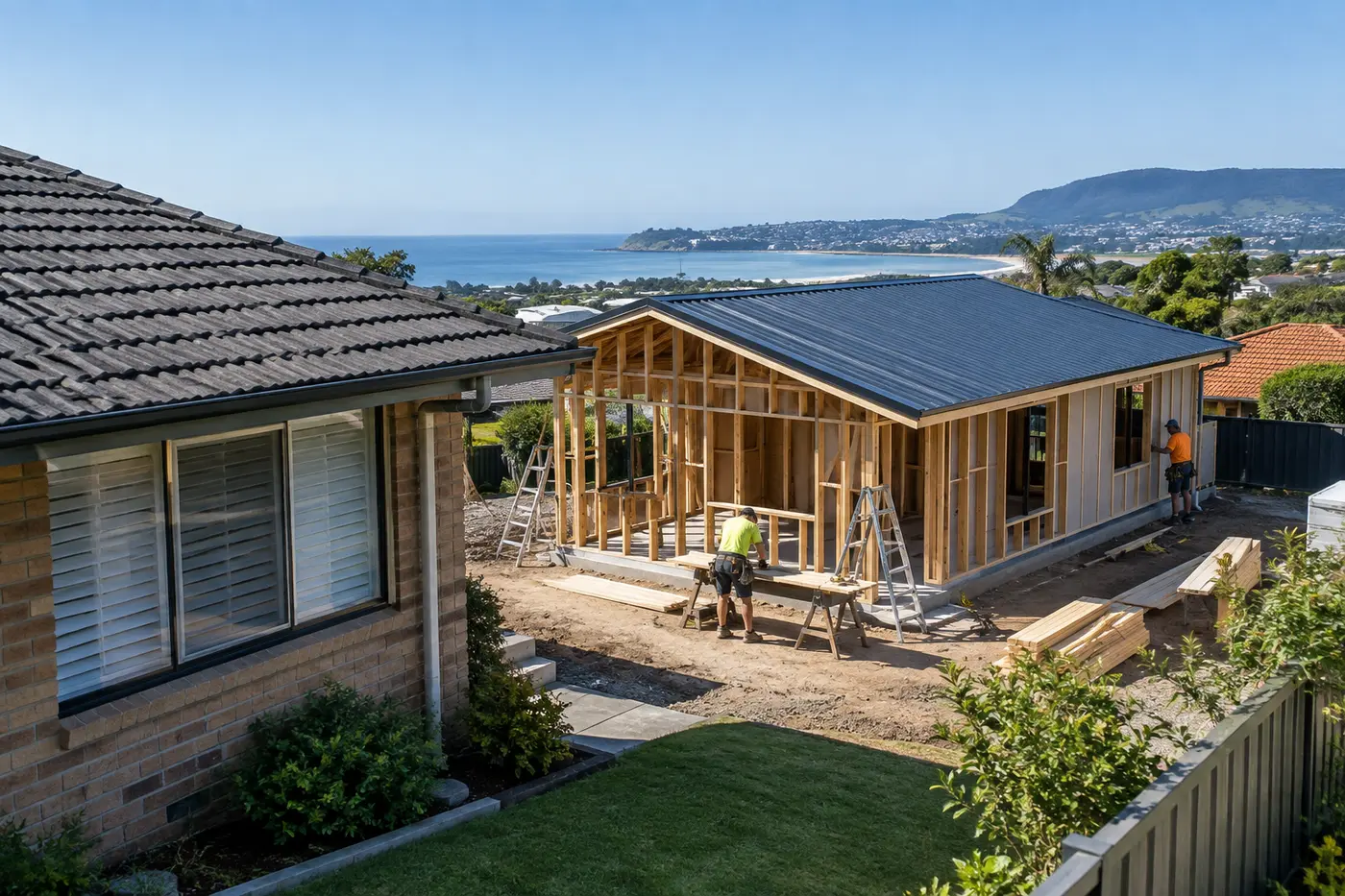
A construction loan is built for exactly this kind of job. Instead of handing you the whole amount as a lump sum, the lender releases the money in stages as the build hits set milestones. The usual stages are slab down, frame up, lock-up, fit-out and completion. Your builder invoices at each stage, the lender inspects or checks progress, and then pays that portion.
There is a genuine upside to this drip-feed approach. You generally only pay interest on the money that has actually been drawn, not the full loan amount from day one. So while the slab is going in, you are only paying interest on that first slice, not the lot. It keeps your holding costs down during the build itself.
The catch is that construction loans come with more moving parts. Lenders want a fixed-price building contract, a set of approved plans and a clear schedule before they release a cent. This is where working with a builder who does fixed-design, fixed-price granny flat construction genuinely helps. When the contract price and the plans are locked in from the start, the bank has everything it needs and there is far less back and forth.
What lenders look at before they say yes
Three things tend to decide whether the money comes through, and in what amount.
- Your equity and the valuation. The bank will value your property and work out how much you can safely borrow against it. More equity means more room to move.
- Serviceability. This is the plain question of whether you can afford the repayments on your income, after your other commitments. Some lenders will count a portion of the expected rent from the granny flat towards this, which can lift how much they will lend. Not all do, and the ones that do usually only count part of it, so ask.
- The build itself. A clear fixed-price contract and approved plans reassure the lender that the project is real, costed and going to finish. Vague quotes and open-ended scopes make banks nervous.
The practical takeaway: the tidier your build documentation, the easier the finance. That is one of the quiet advantages of a CDC-approved fixed design, because the approval pathway and the price are settled early.
Where cash and savings fit in
Even when you borrow the bulk of it, having some cash on hand smooths things out. Upfront costs like the certifier, surveys and any service connections often need paying before the first loan stage releases. Some people use an offset account or redraw on their existing loan rather than a formal top-up, which can be cheaper and quicker for a smaller build. Whether that works depends on your loan and how much you have available, so it is a conversation for your lender.
We would gently steer you away from draining your entire emergency buffer to avoid borrowing. Builds occasionally throw up a surprise, and it is much less stressful to have a little slack than to be scrambling mid-project.
Budget for more than just the build
One thing we see catch people out is financing only the headline build figure and forgetting the extras around it. Approval and certification fees, site costs if your block is sloped or tricky, connecting water, sewer and power, and a landscaping tidy-up at the end all add up. When you set up your finance, it is worth borrowing for the full project rather than just the build so you are not topping up cash halfway through. For a realistic breakdown of the numbers, our guide on what a granny flat costs in NSW is the place to start before you talk to a lender.
Our honest advice on the order to do things
Get a rough sense of your borrowing power early, before you fall in love with a design. A short chat with your bank or a broker about your equity and serviceability tells you what budget you are actually working with. Then bring us in for a free site inspection so we can confirm what will fit and give you a fixed price to take back to the lender. Finance approval and design tend to fall into place quickly once both sides are talking with real numbers rather than guesses.
Straight answers about granny flat finance
Can I use the equity in my home to build a granny flat?
Yes, and it is the most common way our clients fund a build. If your home is worth more than you owe on it, most lenders will let you borrow against that difference. Because the loan is secured against a property you already own, you often will not need a separate cash deposit.
Do I need a deposit to build a granny flat?
Not always. If you are borrowing against home equity, that equity effectively stands in for a deposit, so some lenders will fund the full build cost. It still helps to have some cash on hand for the early upfront fees that fall due before your loan starts releasing funds.
What is a construction loan and how does it work?
It is a loan designed for building, where the lender pays out in stages as the work is completed rather than all at once. You usually only pay interest on the amount drawn so far, which keeps costs down during the build. Lenders will want a fixed-price contract and approved plans before they approve one.
Will the bank count the rent from the granny flat?
Some lenders will include a portion of the expected rental income when they work out how much you can borrow, which can lift your limit. Others do not count it at all until the flat is built and tenanted. It varies between banks, so it is worth asking directly or getting a broker to compare.
Are there government grants for building a granny flat in NSW?
For a standard granny flat you build to rent out or house family, there is no general government grant in NSW. Funding almost always comes from your own equity, a construction loan or savings. Disability-related accommodation sits under separate schemes, which is a different situation worth raising with a broker.
Can I finance a granny flat on my parents’ property?
It can be done, but it is more involved because the loan and the land ownership need to line up. Lenders will want to know who owns the property and who is on the loan, and family arrangements sometimes need a formal agreement. Get advice from a broker before you commit, because the structure matters here more than usual.
Ready to get a fixed price for your lender?
The finance side moves fastest when you can hand your bank a clear, fixed-price contract and approved plans. That is exactly what we deliver. Book a free site inspection or call us on (02) 4203 3554, and we will confirm what fits your block and cost it up properly, so you have real numbers to take to your lender. See how our granny flat construction service keeps the price and the plans locked in from day one.