Most people who ring us with this question are standing in their backyard looking at a patch of lawn they never use. They want to know one thing before they spend a cent: does a granny flat add value, or are they about to pour money into something that won’t come back when they sell? It’s a fair question, and the honest answer has a few moving parts.
We build granny flats across the Illawarra and Southern Highlands, so we see how these numbers play out on real blocks, not just in a spreadsheet. Here’s how we’d talk it through if you were a neighbour asking over the fence.
The short answer, and the bit nobody says out loud
Yes, in most cases a well-built granny flat adds value. But two things decide whether it adds a lot or a little: how good the build is, and what the rental market near you looks like. A tidy, separate, second dwelling on a block in a suburb where people actually want to rent is worth real money. A cramped, awkward one that eats the whole backyard can do the opposite.
So the useful question isn’t really “does it add value”. It’s “how much, and what do I need to get right”. That’s where the rest of this comes in.
How much value it actually adds
You’ll see a figure quoted everywhere online. CoreLogic data, which agents like LJ Hooker have repeated for years, suggests a well-built granny flat can lift a property’s total value by around 20 to 30 per cent. That’s a headline number, not a promise, and it swings hard depending on the suburb, the block and the quality of the build.
The two levers that move it are simple. One is the extra capital value the second dwelling adds to the property on paper. The other is the income it can produce, which is what turns an owner-occupier’s home into something an investor will pay a premium for. In the Illawarra, where rentals are tight and close to Wollongong, the income side does a lot of the heavy lifting.
Two ways it pays you back
Value shows up in two places, and they don’t arrive at the same time.
The first is resale. When you list a three-bedroom house with a separate, approved granny flat, you’re selling to a bigger pool: families who need space for a parent or an adult child, and investors chasing dual income off one title. More buyers competing usually means a stronger price.
The second is rent. Industry figures often quoted from CoreLogic put properties with a granny flat at roughly 27 per cent higher weekly rent than those without. That rental return is the engine behind most granny flat builds, and it’s the reason so many of ours are investment-driven. If you want the full picture on how the numbers stack up over time, we go deep on it in our piece on why a second dwelling stacks up as an investment.
Cost versus value, where people trip up
Here’s the trap. A granny flat that costs, say, $200,000 to build does not automatically add exactly $200,000 to your valuation the day it’s finished. CommBank make this point in their own granny flat guidance, and they’re right. The immediate lift in equity and the build cost are two different numbers, and early on they rarely match to the dollar.
That’s not a reason to walk away. It’s a reason to think in terms of the whole return, not just resale. The rent it earns from day one, the tax position, and the capital value over a few years is where the real payback sits. Build it cheap and nasty and you’ll feel the gap. Build it well, on the right block, and the gap closes fast. Before you commit, it’s worth knowing what a granny flat actually costs in NSW so your expectations and your budget line up.
What lifts the value, and what kills it
After enough builds you start to see the same handful of things separate a granny flat that adds value from one that drags on the sale. These are the ones that matter most.
- It keeps a usable backyard. Buyers still want some yard. Swallow the whole block with the build and you’ve traded one asset for another, which nets you very little.
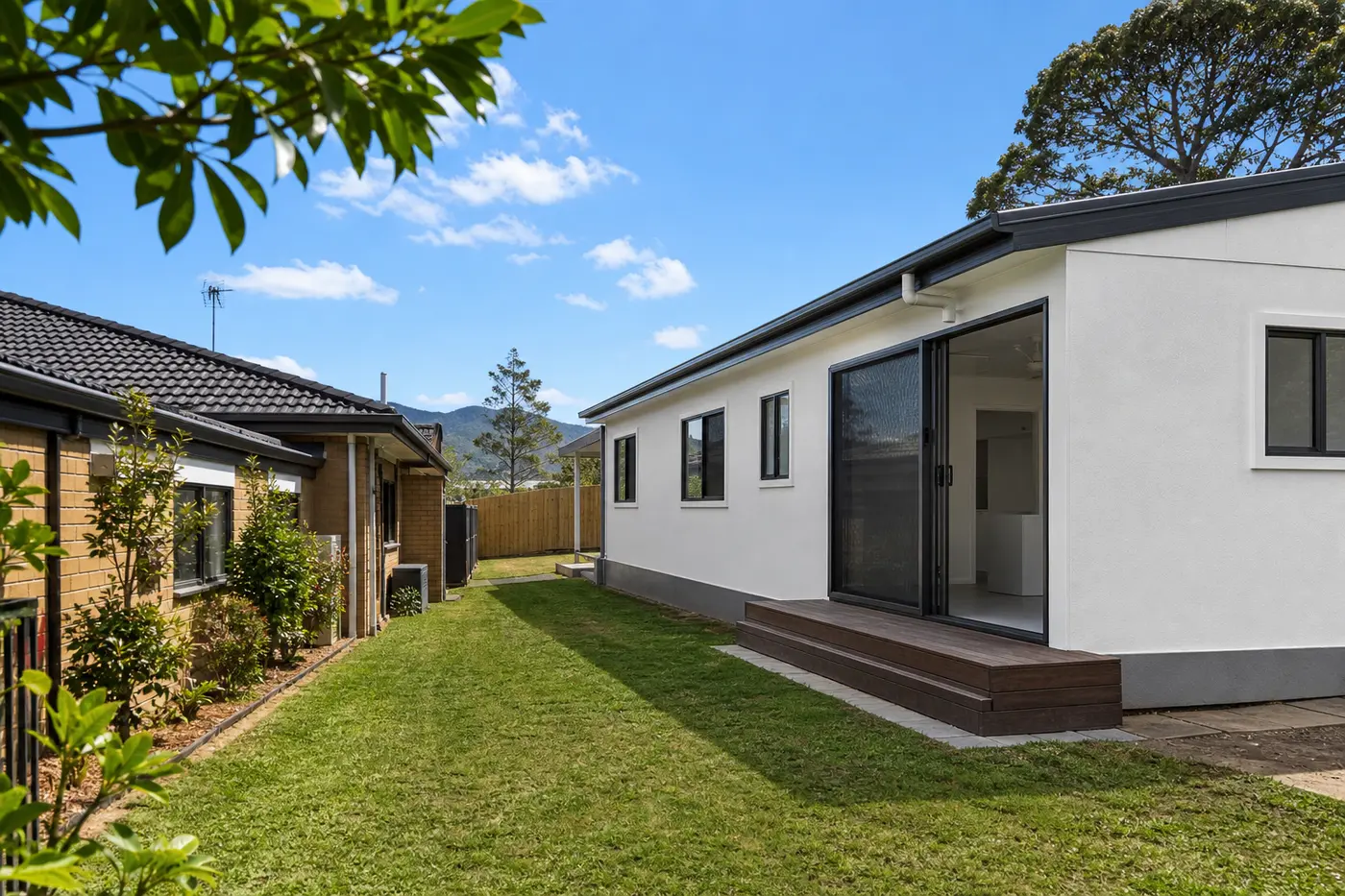
- It has genuinely separate access. A private entrance, its own outdoor space and, ideally, separate metering make it feel like a real second home rather than a converted garage. Tenants pay more for that, and so do buyers.
- The bedroom count suits the market. A studio rents, but a two-bedroom flat usually rents for more and appeals to a wider group. Most of the value-focused jobs we do end up as two-bedroom granny flat builds for exactly that reason.
- It’s properly approved. An unapproved or dodgy build is a liability at sale, not an asset. A CDC-approved, compliant dwelling is clean paperwork a buyer’s solicitor won’t flinch at.
- The build quality holds up. Cheap finishes date fast and photograph badly. Solid materials and a considered layout are what make a valuer and a buyer take it seriously.
Get those right and the value question mostly answers itself. Get them wrong and even a big spend can underwhelm.
Why the Illawarra is a sensible place to do this
Location decides a big chunk of the answer, and this region does well on the things that count. Rental demand across Wollongong and the surrounding suburbs is strong, the area pulls families who want to keep a parent or adult child close by, and blocks here are often generous enough to take a second dwelling without losing the yard.
We’re locals, backed by Jaya Builds, so we know which streets and which block shapes work and which don’t before we ever quote. That’s the difference between a granny flat that adds value on paper and one that adds it in practice. We’ve watched it happen: one of our Dapto clients turned a negatively geared property into positive cashflow with a single build, which you can read about in our Dapto investor case study.
So, is it worth it for you?
If your block can take one, your suburb rents well, and you build it properly, a granny flat is one of the more reliable ways to add both income and value to a property in this region. The number on the valuation matters, but the rent it earns while you hold it usually matters more.
If you’d like a straight answer for your specific block, we’re happy to look at it with you. Have a chat with us about a two-bed granny flat build and we’ll tell you honestly whether it stacks up, or call us on (02) 4203 3554.
Common questions about granny flats and property value
How much value does a granny flat add to a property?
Widely quoted CoreLogic figures put the lift at around 20 to 30 per cent of the property’s value for a well-built flat, though the real number depends on your suburb, block and build quality. In a high-demand rental area like the Illawarra, the income it produces often matters as much as the valuation.
Can a granny flat lower your property value?
It can, if it’s done badly. Taking up the entire backyard, poor build quality, or an unapproved dwelling can put buyers off and drag on the price. A separate, well-designed and properly approved flat that leaves usable yard almost always adds value rather than subtracting it.
Do granny flats add more value than a home extension?
Often, yes, because a granny flat can be rented as a separate dwelling while an extension usually can’t. That dual-income potential appeals to a wider group of buyers, particularly investors. An extension can still make sense if you simply need more space in the main house rather than a second income.
Will I get my build cost back straight away?
Not always on day one. The immediate jump in your valuation and the amount you spent building are two different numbers, and they rarely match exactly at first. The full return comes from the rent it earns plus the capital value over a few years, which is why it pays to think beyond the resale figure alone.
Does a two-bedroom granny flat add more value than a studio?
Usually. A two-bedroom flat appeals to families and small households, tends to command higher rent, and suits a broader slice of the market. A studio still rents and costs less to build, so the right choice comes down to your block size and who you expect to rent to.
What are the disadvantages of a granny flat?
The main trade-offs are the loss of some backyard, the upfront build cost, and the ongoing job of being a landlord if you rent it out. There can also be tax and land considerations worth checking with your accountant. For most Illawarra owners with a suitable block, the income and added value outweigh these, but it’s worth going in with eyes open.