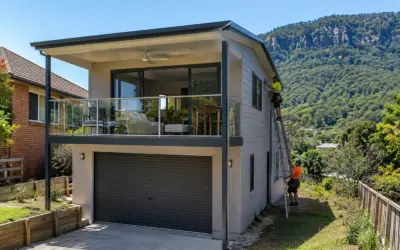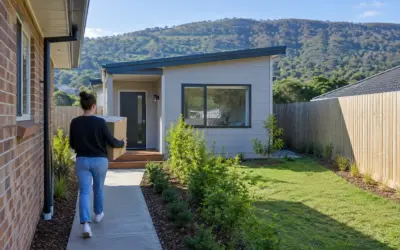

The conversation usually starts at our free site inspection. Your mum has sold the family home in Figtree or she’s about to, and the plan is that she’ll move into a new granny flat in your backyard. She wants to put some of the sale money toward the build. It feels fair to everyone, and it often is. But before that money changes hands, there’s one thing most families haven’t heard of: a granny flat agreement, and the Centrelink rules that sit behind it.
Get this part right and the arrangement can leave her pension untouched. Get it wrong and the money she put into the flat can be treated as a gift and counted against her for five years. We’re builders, not lawyers or financial planners, so this post isn’t advice for your situation. It covers what we explain to families before they sign anything with us, and the questions worth taking to a professional.
To Centrelink, a “granny flat” isn’t a building at all
This catches a lot of people out. When we say granny flat, we mean a self-contained second dwelling on your block. When Centrelink says it, they mean a granny flat interest: an arrangement where an older person pays money, transfers assets or hands over the title to their home in exchange for the right to live somewhere for the rest of their life.
That right could be a spare room in your house. It could be a converted garage. It could be a brand new flat we build behind your place. Centrelink cares about the deal, not the floor plan. So the fact that you’ve had a secondary dwelling approved doesn’t create a granny flat interest on its own. The agreement between you and your parent does that.
There’s also a planning reason the agreement matters so much in NSW. A secondary dwelling can’t be subdivided off and sold separately from the main house. Your mum can pay for a large share of the flat and still never own it, because it sits on your title. Her protection is the right to live there, so that right needs to be clear.
When paying for the build doesn’t count as a gift
Normally, if a pensioner gives away more than $10,000 in a financial year, or more than $30,000 over five financial years, Centrelink treats the extra as a “deprived asset”. It still counts toward the assets test for five years, even though the money is gone. Without the granny flat rules, a parent who handed over a large sum to fund a build could lose part or all of their pension.
A genuine granny flat interest is treated differently. If the amount your parent pays is considered reasonable for a lifetime right to live there, it isn’t counted as a gift. Where they pay with cash or other assets rather than transferring the title of their home, Centrelink uses a reasonable amount test, a formula based on their pension and life expectancy. Anything paid above that figure can be assessed as a gift under the normal rules.
We see this play out with sale proceeds more than anything else. A parent sells a house, has a large lump sum sitting in the bank, and wants to cover the whole build plus a bit extra “to help out”. That extra is exactly the kind of amount that can end up being treated as a gift. Find out the reasonable amount before agreeing on a number, not after.
Homeowner or not: why the dollar figure matters twice
How much your parent contributes also decides whether Centrelink classes them as a homeowner. The comparison point is called the extra allowable amount, which is the gap between the assets test limits for homeowners and non-homeowners.
If they pay more than that amount, they’re generally treated as a homeowner and the granny flat interest isn’t counted as an asset. If they pay less, they may be treated as a non-homeowner, which can open up Rent Assistance if they’re also paying you rent. Neither outcome is automatically better. It depends on their other assets and income, and that’s a question for Centrelink’s free Financial Information Service or a financial adviser.
The five-year rule is where arrangements come unstuck
If the arrangement ends within five years and Centrelink decides that was foreseeable or within the family’s control, it can go back and treat the original payment as a gift from the date it was made. Plenty of things can trigger it: a falling out, a divorce, a decision to sell the house and move interstate.
Things outside anyone’s control are treated differently. A parent who needs to move into aged care because their health has changed is the common example. Even so, the aged care side has its own means testing, and a granny flat interest can affect how fees are worked out. Get advice on that before the build, while there’s still time to change the plan.
Our practical take from the families we’ve worked with is simple. Talk honestly about the next five years before anyone pays a deposit. If there’s a real chance the main house will be sold, or a marriage is under strain, the arrangement may not suit, however good the flat turns out.
Put the agreement in writing, even though Centrelink doesn’t insist
Centrelink can recognise a granny flat interest without a formal document. But it will want evidence of what was paid and what the parent received in return, and a written agreement is the clearest proof you have. It also protects your parent, who otherwise has a large amount of money tied up in a property they don’t own.
A good agreement, drawn up by a solicitor who handles these regularly, usually covers:
- how much is being paid and what it’s for
- the right to live in the flat for life, and whether that includes shared areas like the driveway and laundry
- who pays for maintenance, rates, power and water
- what happens if the main house is sold, or the owner dies, divorces or goes bankrupt
- whether any money is repaid if the parent moves into care or out of the flat
There’s a tax side too. Since 1 July 2021, a formal written granny flat arrangement with an eligible older person or a person with a disability can be exempt from capital gains tax when the right is created. That only applies if the agreement is in writing, so it’s one more reason to do it properly. Your accountant can confirm whether it applies to you.
How this fits around the build itself
From our side, the building contract is normally signed by whoever owns the land, because the work goes on their title. The money can still come from your parent, but the agreement between you two should be sorted before you sign with us, so it reflects what’s actually being built and what it costs. That’s why it pays to get a clear, written quote from us early. It gives the solicitor and the adviser a real figure to work with instead of a guess.
Design matters as well, because the flat needs to work for someone who might be living there for twenty years or more. For a parent, it’s worth thinking about level access from the driveway, a shower without a hob to step over, wider doorways and a bedroom close to the bathroom. Our self-contained granny flats for family members are designed as fully independent homes with their own kitchen and bathroom, so your parent isn’t relying on the main house day to day.
If your parent’s contribution won’t cover everything, the rest usually comes from equity in your own home or a construction loan. We’ve set out the main options in our guide to paying for a granny flat in NSW. Be aware that if your lender ever had to sell the property, a parent without a clear written agreement could be in a very weak position.
If you’d like to see how one local household approached keeping family close, our Thirroul family case study is a good place to start.
A sensible order of events
When families ask us where to start, this is the order we suggest. First, have us check the block and give you a fixed price, so everyone knows the real cost. Next, your parent speaks to the Financial Information Service or a financial adviser about the reasonable amount and their homeowner status. Then a solicitor drafts the granny flat agreement around those figures. Only after that should money move and contracts be signed.
It adds a few weeks at the front of the project. Compared with five years of a reduced pension, it’s well worth it.
If you’re planning a flat for a parent anywhere in the Illawarra or Southern Highlands, call us on (02) 4203 3554 or book a free site inspection. We’ll give you the real figures your adviser and solicitor need, and show you how our self-contained granny flat designs can be set up for someone planning to stay for the long term.
Common questions about granny flat agreements and Centrelink
How is a granny flat assessed for Centrelink?
Centrelink looks at the arrangement rather than the building. If your parent pays money or transfers assets in exchange for a right to live in the property for life, that’s a granny flat interest. The amount paid is checked to see whether it’s reasonable, and it also decides whether they’re treated as a homeowner for the assets test.
Does a granny flat agreement need to be in writing?
Not strictly. Centrelink can accept that a granny flat interest exists without a formal document. In practice a written agreement is the best evidence you’ll have, it protects your parent if circumstances change, and it’s required for the capital gains tax exemption on granny flat arrangements.
Is there a Centrelink granny flat agreement template?
Centrelink doesn’t supply one. Templates are available online, but every family’s situation is different, especially around what happens if the house is sold or the arrangement ends. A solicitor who regularly drafts these agreements is the safer option.
What happens if mum moves out within five years?
If the arrangement ends within five years and Centrelink decides it was foreseeable or within your control, the original payment can be treated as a gift and counted against her assets. If it ends for reasons outside anyone’s control, such as a health decline that means she needs aged care, that usually isn’t the case. Ask a financial adviser how this applies to your situation.
Can my parent get Rent Assistance living in our granny flat?
Possibly. If the amount they paid for the granny flat interest is less than the extra allowable amount, they may be treated as a non-homeowner, and Rent Assistance may then be available if they also pay rent. The Financial Information Service can run through the numbers with them for free.
Does a granny flat have to be a separate building for Centrelink?
No. A granny flat interest can apply to a room in the main house, a converted space or a separate dwelling. A self-contained flat simply gives everyone more independence and privacy, which is why many families choose to build one.